
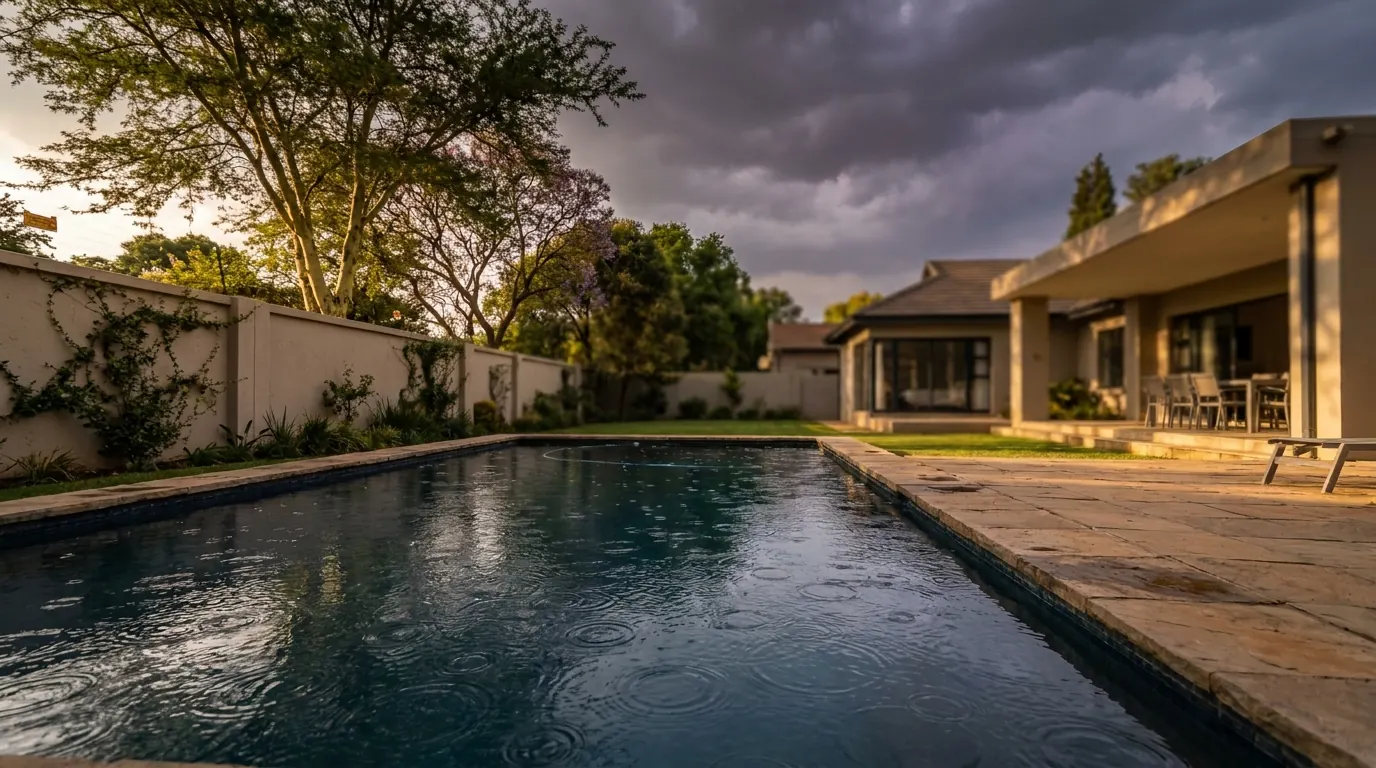
The year at a glance
Johannesburg’s summer rain and dry winter change the debris load and how the pool is used. The calendar below is a planning prompt; water test results, equipment instructions and the condition of your pool decide the work.
| Month | Focus |
|---|---|
| January | Remove storm debris and test after heavy rain and busy swimming days. |
| February | Continue brushing and testing; investigate persistent cloudy water. |
| March | Review actual use and circulation before adjusting the timer. |
| April | Watch leaf accumulation and keep baskets clear. |
| May | Prepare the cover if used; maintain testing and circulation. |
| June | Check water balance and equipment even when nobody swims. |
| July | Inspect accessible equipment for leaks and record unusual water loss. |
| August | Clear windblown debris and arrange pre-season repairs. |
| September | Review the pool before swimming resumes; test safety gates and covers. |
| October | Prepare for storms; check baskets, drainage and timer settings. |
| November | Increase observation and testing as use rises. |
| December | Plan holiday care and keep testing between contractor visits. |
Calculate circulation accurately
Nominal turnover is flow multiplied by running time, divided by pool volume. As an example, assume a measured flow of 10,000 litres/hour:
12 hours: 120,000 litres circulated, or 3 nominal turnovers of a 40,000-litre pool and 2.4 of a 50,000-litre pool.
8 hours: 80,000 litres circulated, or 2 and 1.6 nominal turnovers respectively.
The flow is an assumption for this calculation, not a performance claim for every 0.75 kW pump. Pipes, filter condition and operating head affect actual flow. Nominal turnover also does not mean every drop has passed through the filter.
After a power cut, check actual timer operation and restore the schedule recommended for the system. Do not open electrical timer wiring yourself. Low flow, a pump that will not prime or repeated tripping needs diagnosis; see pool repairs.
Test before dosing
Filtration does not replace disinfection. CDC recommends routine chlorine and pH testing, at least twice daily for home pools and more often with heavy use. It gives a pH range of 7.0–7.8 and distinguishes chlorine targets for pools with and without stabiliser. Use the appropriate product label and qualified pool advice for your system.
Do not add acid, clarifier, stabiliser or shock treatment simply because a month has arrived. Test first and follow the prescribed dose and re-entry conditions. Cold water alone does not establish a scaling problem; assess the complete water balance before treatment.
A fortnightly contractor visit is not a replacement for the checks needed between visits. Agree who performs them.
What a maintenance quote should include
Use the pool maintenance price guide to compare recurring schedules with individual visits. Pool size, chemicals, condition and agreed attendance affect the quote; a complex pool needs its own scope.
- Number of visits and holiday cover.
- Water readings and treatments recorded each visit.
- Cleaning, filter care and equipment observation.
- Which chemicals and consumables are included.
- Responsibility for daily checks and fault reporting.
- Separate approval for repairs and green-pool recovery.
Sources and further reading
Use the instructions for your equipment or coating. Prices in this guide are indicative planning estimates, not a quote from The Home Crew.
Pool maintenance
Tell us your suburb, the work needed and any access restrictions. Photos help us assess the next step.
View service and guide prices