
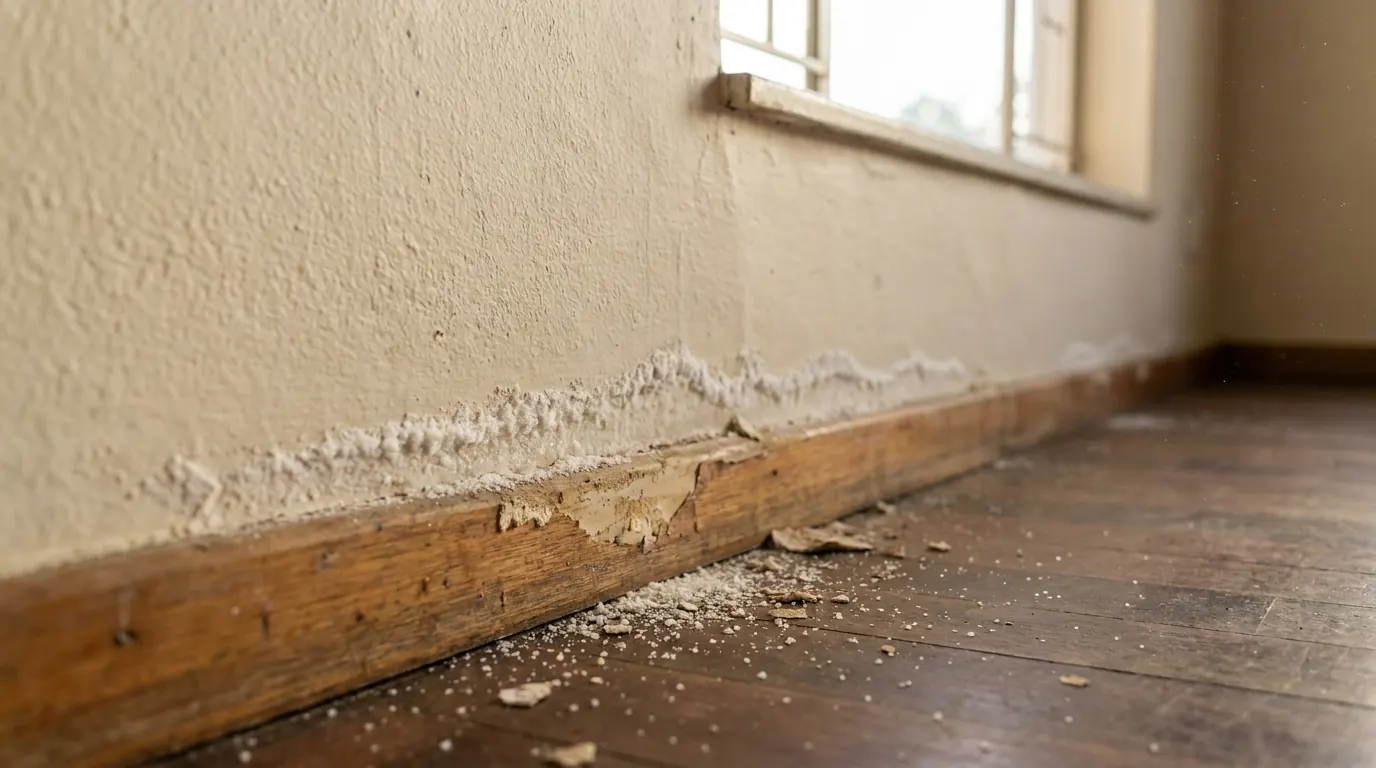
Compare the pattern, then investigate
| Observation | Possible causes to investigate |
|---|---|
| Low-level damp and damaged skirtings | Ground moisture, bridged damp protection, plumbing or floor-to-wall defects |
| A patch that worsens after rain | Roof, gutter, flashing, window or external-wall defects |
| Moisture on cold corners or windows | Condensation, humidity and limited ventilation |
| A local patch near plumbing | Supply or waste-pipe leakage |
These are leads for an inspection, not a diagnosis from a photograph. Several sources can affect the same wall. A tide mark or a surface moisture-meter reading alone does not establish active rising damp.
What a useful inspection records
- Location, height and extent of the staining, including adjacent rooms.
- When it appears and whether it changes with rain, bathing or heating.
- External ground levels, drainage, gutters and visible wall defects.
- Relevant plumbing routes and previous repairs.
- Moisture patterns and further testing where the cause remains uncertain.
Safeguard’s technical guidance explains that surface electrical meters provide indications, not absolute proof. Salts and previous work can affect readings. Ask the assessor to explain the evidence and alternative causes ruled out.
Treat the source before the finish
Repairing a leak, improving drainage, addressing a bridged damp barrier and managing condensation are different jobs. The repair specification should explain which cause is being addressed and how drying and follow-up will be assessed.
For condensation, assess moisture production and ventilation rather than defaulting to an injection treatment. EPA guidance identifies moisture control as central to preventing mould. Persistent or extensive damage needs appropriate assessment before finishes are replaced.
Paint or fresh plaster can conceal the appearance temporarily without resolving the water source. Ask whether affected finishes need removal, how salts will be handled and when redecorating is suitable for the proposed system.
Understand the quote’s units
Use the damp-proofing price guide for current planning ranges. Injection is measured in linear metres; replastering is measured in square metres. As an arithmetic example, assume R450–R1,100 per linear metre for injection and R600–R1,200 per square metre for replastering. An 8-metre wall with a 1-metre-high repair band then gives R3,600–R8,800 for injection plus R4,800–R9,600 for 8 m² of replastering. These assumed rates illustrate the units, not a treatment quote.
That example explains units, not the treatment your wall needs. Confirm measured quantities, preparation, drying arrangements, finishes, VAT and exclusions. For roof or external water ingress, the appropriate scope may instead be waterproofing or a targeted building repair.
Sources and further reading
Use the instructions for your equipment or coating. Prices in this guide are indicative planning estimates, not a quote from The Home Crew.
Damp assessment and repairs
Tell us your suburb, the work needed and any access restrictions. Photos help us assess the next step.
View service and guide prices